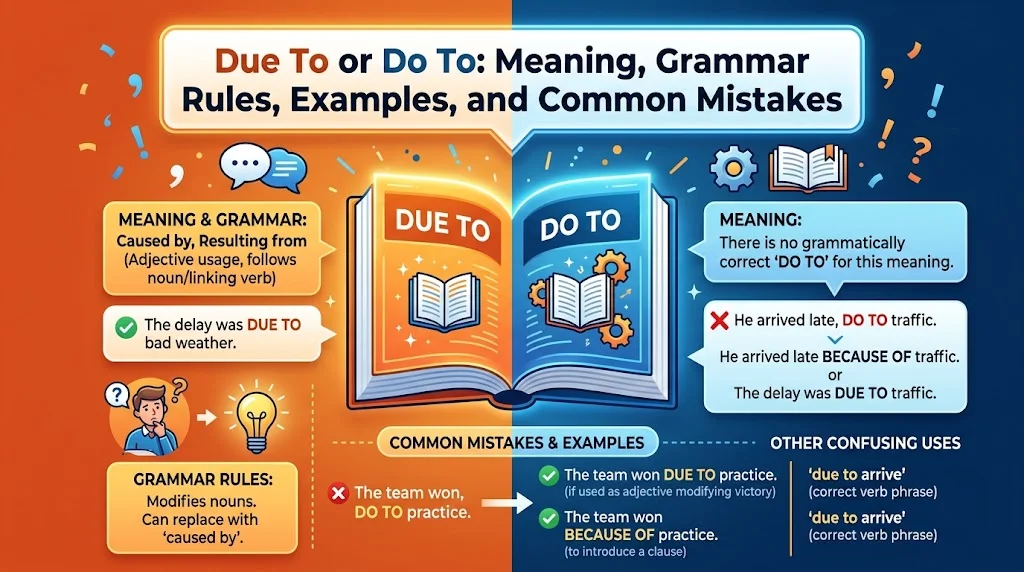
If you’ve ever paused while writing Due To or Do To, you’re not alone. These two forms sound nearly identical in everyday speech, yet they don’t serve the same purpose in a sentence. One commonly explains a reason or cause, while the other combines the verb do with to.
That tiny difference can create a surprisingly noticeable grammar mistake.
Consider these sentences:
- The flight was delayed due to bad weather. ✅
- The flight was delayed do to bad weather. ❌
- What did you do to my phone? ✅
The first sentence explains a cause. The third describes an action performed on something. The second uses do to where due to is required.
Understanding this distinction doesn’t require memorizing a complicated grammar chart. Once you know what each expression means and how it behaves in a sentence, the choice becomes much easier.
This guide explains Due To or Do To, including their meanings, grammar functions, examples, common mistakes, memory tricks, and practical tests you can use while writing.
What Is the Difference Between “Due To” and “Do To”?
The easiest way to separate due to and do to is to focus on meaning rather than pronunciation.
Quick Answer
Due to commonly means because of, caused by, or resulting from.
The game was canceled due to heavy rain.
Here, due to introduces the reason for the cancellation.
Do to, on the other hand, isn’t a fixed phrase meaning “because of.” It is simply the verb do followed by to. It appears when do describes an action involving a person, object, or situation.
What did you do to the computer?
The question asks about an action performed on the computer.
Here’s the core distinction:
| Expression | Main function | Basic meaning | Example |
| Due to | Explains a cause | Because of | The delay was due to traffic. |
| Do to | Describes an action | Do something to someone/something | What did you do to the car? |
So, if you’re explaining why something happened, due to may be the expression you’re looking for.
If you’re talking about an action involving something or someone, do to may be correct.
“Due To” Means “Because Of”
A useful first test is simple.
Can you replace due to with because of without changing the basic meaning?
If yes, due to is probably the form you need.
For example:
The meeting was postponed due to a scheduling problem.
You can rewrite it as:
The meeting was postponed because of a scheduling problem.
The basic reason remains the same.
“Do To” Uses the Verb “Do”
The word do functions as a verb in expressions such as:
- What did you do to him?
- What will this change do to the project?
- Don’t do to others what you wouldn’t want done to you.
- What can we do to improve the situation?
Here, do carries the action. The word to connects that action with its object or another construction.
That is completely different from due to.
Why They Sound Similar but Work Differently
The confusion mainly comes from pronunciation.
In ordinary speech, due to and do to can sound extremely similar. When you’re speaking quickly, the difference may almost disappear.
Writing doesn’t give you that luxury.
On the page, the spelling tells the reader which construction you’re using. That’s why you need to identify the intended meaning before choosing the letters.
Understanding “Due To”
Due to is commonly used to introduce a cause or reason. In traditional grammar, due functions as an adjective in constructions such as:
The cancellation was due to bad weather.
Here, the phrase identifies the cause of the cancellation.
The MLA Style Center recommends testing due to by replacing it with attributable to. If that substitution works naturally, the construction fits the traditional grammatical pattern.
Meaning and Definition of “Due To”
In its causal use, due to can express ideas such as:
- because of
- caused by
- resulting from
- attributable to
- owing to
For example:
The delay was due to heavy traffic.
The phrase tells readers what caused the delay.
Another example:
Her absence was due to illness.
Again, due to introduces the reason connected to the noun absence.
When to Use “Due To”
Use due to when you want to identify the cause of something.
Examples include:
The cancellation was due to severe weather.
The company’s growth was due to strong customer demand.
His success was due to years of practice.
The error was due to a software problem.
The delay was due to a technical issue.
Notice the pattern. The phrase points toward a cause.
“Due To” as a Prepositional Phrase
Here’s where grammar gets interesting.
Traditional grammar treats due to differently from because of. In the traditional analysis, due acts as an adjective and should modify a noun or noun phrase.
For example:
The delay was due to heavy traffic.
The noun delay is connected to its cause, heavy traffic.
The MLA Style Center gives a similar test with sentences such as “The tennis match’s delay was due to the rain.” It explains that due to can be replaced by attributable to in this structure.
However, modern English doesn’t always follow that traditional restriction.
The Chicago Manual of Style notes that the older rule against using due to at the beginning of a sentence is losing ground because modern usage increasingly accepts that construction.
The Language Portal of Canada makes the distinction especially clear: it describes a formal use of due to as an adjective and also recognizes an informal use in which due to functions like a compound preposition similar to owing to.
That means you may encounter both of these:
The delay was due to heavy traffic.
Due to heavy traffic, the meeting started late.
The second construction is common in modern English, although some formal style guidance still recommends because of or owing to instead.
Examples of “Due To” in Everyday Sentences
Here are some natural examples:
- The train was late due to a mechanical problem.
- The store closed early due to a power outage.
- The match was postponed due to rain.
- The website was unavailable due to maintenance.
- The student missed class due to illness.
- The project slowed down due to a lack of funding.
- The road was closed due to flooding.
- The event changed locations due to construction.
Each example identifies a cause.
Examples in Formal and Academic Writing
Due to also appears frequently in formal writing:
The decline was due to reduced consumer demand.
The variation was due to differences in sample size.
The results were affected by conditions due to environmental changes.
However, formal writing benefits from precision. Don’t automatically choose due to simply because it sounds more sophisticated.
Sometimes because of, owing to, or as a result of creates a cleaner sentence.
For example:
The experiment failed because of contamination.
This can be clearer than forcing due to into the sentence.
When “Due To” Can Be Replaced With “Because Of”
Try this substitution:
The cancellation was due to rain.
→
The cancellation was because of rain.
The meaning remains understandable.
Another example:
The team’s loss was due to poor preparation.
→
The team’s loss was because of poor preparation.
Again, the basic meaning stays intact.
This substitution test is useful because because of is usually easier to recognize as a causal phrase.
Common Sentence Patterns With “Due To”
Some common structures include:
Noun + be + due to + cause
The delay was due to traffic.
Noun + was + due to + noun phrase
The cancellation was due to bad weather.
Due to + noun phrase + main clause
Due to heavy snow, the roads became dangerous.
The last pattern is widely used in modern English. However, if you’re writing for a strict formal style, because of or owing to may be preferable at the beginning of a sentence.
Read More: Courtesy vs Curtesy: What’s the Difference? A Complete Guide
Understanding “Do To”
Now for the other side of the pair.
Do to is not the causal expression you’re looking for when you mean because of.
Instead, it is often a normal combination of the verb do and the word to.
What “Do To” Actually Means
Consider:
What did you do to my laptop?
The speaker isn’t asking for a reason.
They’re asking what action someone performed involving the laptop.
Likewise:
What will this change do to our schedule?
The question asks about the effect or consequence of an action.
How “Do” and “To” Work Together
The verb do can describe an action, while to connects that action to another element.
For example:
What did you do to the door?
What can we do to fix this?
Don’t do to others what you wouldn’t want them to do to you.
The exact grammatical structure can vary depending on what follows to.
That matters because do to isn’t a single replacement for due to.
Examples of “Do To” in Questions
Questions provide some of the clearest examples:
What did you do to my phone?
What did the storm do to the roof?
What will the new policy do to small businesses?
What can we do to solve this problem?
What did the accident do to the vehicle?
In each case, do is performing its normal grammatical job as a verb.
Examples of “Do To” in Statements
The construction can also appear in statements:
The chemical reaction did something unexpected to the material.
Stress can do to your body what lack of sleep does to your mind.
We need to consider what this change could do to the system.
Again, the phrase doesn’t mean because of.
Why “Do To” Is Not a Replacement for “Due To”
This is the mistake to avoid:
❌ The flight was canceled do to bad weather.
The writer means:
The flight was canceled because of bad weather.
Therefore, the correct spelling is:
✅ The flight was canceled due to bad weather.
The difference isn’t merely stylistic. The two constructions perform different grammatical jobs.
Due To vs. Do To: Side-by-Side Comparison
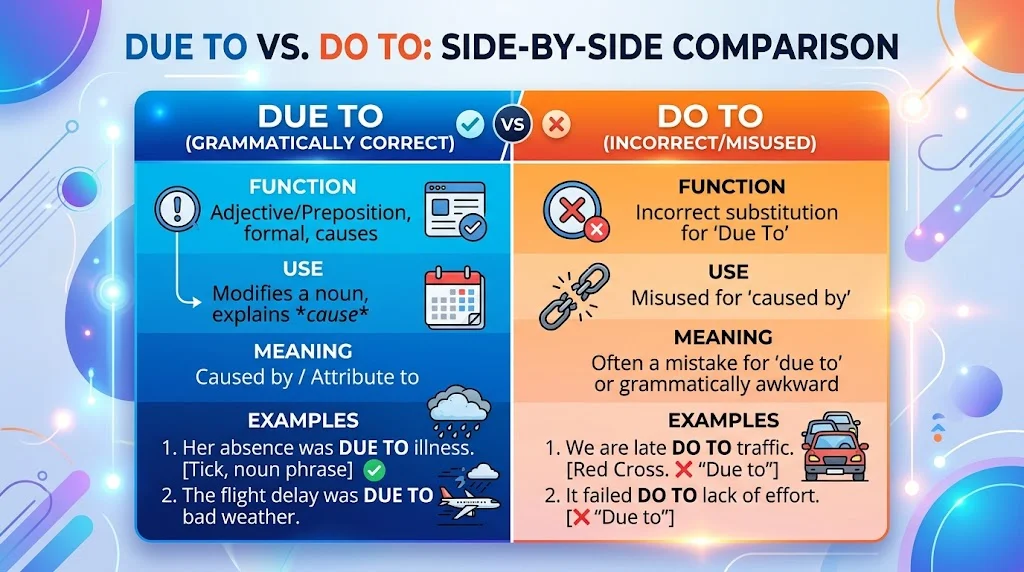
The following table gives you the fastest way to compare them.
| Feature | Due To | Do To |
| Main purpose | Explains a reason | Describes an action |
| Common meaning | Because of | Perform an action toward/on |
| Word structure | Fixed phrase | Verb + preposition/infinitive construction |
| Typical question | Why did it happen? | What did someone do? |
| Example | The delay was due to rain. | What did you do to the car? |
| Can mean “because of”? | Yes | No |
| Common spelling error | Sometimes written “do to” | Sometimes incorrectly used for “due to” |
Quick Rule to Remember
Think about the question your sentence answers.
Why did it happen?
→ Due to
What did someone do?
→ Do to
For example:
The concert was canceled due to rain.
Why was it canceled?
Because of rain.
Now:
What did you do to the concert equipment?
What happened?
Someone performed an action involving the equipment.
Keyword Test: “Because Of” vs. “Action”
Use this two-part test whenever you’re uncertain.
Test A: Because of
The delay was because of traffic.
If the sentence works with because of, due to may be the intended phrase.
Test B: Action
What did you do to the computer?
If you’re describing an action performed on something, do to may be correct.
It’s a small test, but it catches a surprisingly large number of errors.
How to Choose Between “Due To” and “Do To”
Ask Whether You Mean “Because Of”
Start with the meaning.
If your sentence explains a cause, you’re probably dealing with due to.
The event was canceled due to rain.
Ask:
Why was the event canceled?
Answer:
Because of rain.
That confirms the intended meaning.
Look for an Action or Verb
If the sentence asks or explains what someone did to something, check for do to.
What did you do to the printer?
The sentence concerns an action.
It doesn’t explain why something happened.
Replace “Due To” With “Because Of”
This is perhaps the easiest test for English learners.
Original:
The meeting was delayed due to traffic.
Replacement:
The meeting was delayed because of traffic.
The meaning remains clear.
If you wrote:
The meeting was delayed do to traffic.
The sentence doesn’t make sense because do to doesn’t mean “because of.”
Check the Sentence Meaning
Never choose the spelling simply because it sounds right.
Ask:
Am I explaining a cause?
If yes, think due to.
Ask:
Am I describing an action involving someone or something?
If yes, do to may be appropriate.
Read the Sentence Naturally
Reading aloud can expose many writing problems, but this particular error requires an extra step.
Both expressions may sound similar when spoken.
So don’t rely only on your ears.
Read the sentence aloud, then check its meaning. If you’re explaining a cause, verify whether because of fits.
Common Mistakes With “Due To” and “Do To”
Mistake 1: Writing “Do To” When You Mean “Due To”
This is the most obvious spelling mistake.
❌ The game was canceled do to rain.
✅ The game was canceled due to rain.
The writer is explaining the reason for the cancellation.
Mistake 2: Writing “Due To” When the Sentence Describes an Action
The opposite problem can also occur.
What did you due to the computer?
Here, the intended phrase is:
What did you do to the computer?
The sentence asks about an action.
Mistake 3: Assuming Spell Check Will Catch the Error
This is an easy trap.
Both due and do are legitimate English words. Both can appear correctly in sentences. A basic spelling checker may therefore have no reason to treat one as a spelling error.
Consider:
The website stopped working do to an update.
Every individual word is spelled correctly. The problem is that the wrong word was selected.
Grammar software can help with many errors, but context-based mistakes still require human attention.
Mistake 4: Choosing the Phrase Based Only on Sound
Pronunciation can hide the difference.
When people speak quickly, due to and do to can sound very similar.
Writing requires more precision.
Think about meaning first. Spelling comes second.
Mistake 5: Using “Due To” Without Checking Sentence Structure
There is another issue worth understanding.
Traditional grammar guidance distinguishes due to from because of based on what the phrase modifies. The MLA Style Center recommends using the attributable to substitution test.
For example:
The delay was due to the storm.
This works naturally as:
The delay was attributable to the storm.
But consider:
The train was delayed due to the storm.
Traditional grammar would favor:
The train was delayed because of the storm.
Modern English frequently uses due to this way, though some formal style guidance continues to recommend because of or owing to in such cases.
The important point is to recognize the difference between traditional grammatical advice and current widespread usage rather than treating the issue as completely black and white.
“Due To” vs. “Because Of”: Are They Always Interchangeable?
This question causes another layer of confusion.
In everyday English, due to and because of often communicate the same basic cause-and-effect relationship.
Compare:
The match was postponed due to rain.
The match was postponed because of rain.
Most readers understand both immediately.
However, traditional grammar draws a structural distinction between the two. The Chicago Manual of Style notes that the older restriction on due to has weakened considerably in common usage.
The Language Portal of Canada similarly distinguishes the more traditional formal use from the increasingly common informal prepositional use.
How Their Meanings Overlap
Both can identify a cause:
The roads closed because of snow.
The roads closed due to snow.
The causal relationship is essentially the same.
Traditional Grammar Guidance
Traditional guidance generally prefers due to when it modifies a noun or noun phrase.
The closure was due to snow.
Here, due to connects the noun closure with its cause.
By contrast:
The road closed because of snow.
Here, because of works naturally with the verb phrase closed.
Modern Everyday Usage
Modern English speakers frequently use due to in places where traditional grammar would prefer because of.
That doesn’t mean every style guide treats the forms identically.
For highly formal writing, checking the preferred style guide for your audience remains sensible. For general communication, the causal meaning of due to is widely recognized.
When “Because Of” Makes a Sentence Clearer
If you’re unsure about the traditional rule, because of is often a straightforward alternative.
Instead of:
Due to heavy traffic, we arrived late.
You can write:
Because of heavy traffic, we arrived late.
The second version makes the causal relationship immediately obvious.
Likewise:
The event was postponed because of rain.
There’s little room for confusion.
Examples of “Due To” and “Do To” in Context
Context makes the distinction easier to remember.
Everyday Conversation
Due to:
The store closed early due to a power outage.
Do to:
What did you do to your jacket?
School and Academic Writing
Due to:
The experiment failed due to contamination.
Do to:
What did the chemical reaction do to the sample?
Workplace Emails
Due to:
The meeting has been moved due to a scheduling conflict.
Do to:
What will this change do to our delivery schedule?
Professional Writing
Due to:
The decline was due to lower demand.
Do to:
The proposed changes could do to the system what previous updates did to the database.
Incorrect vs. Correct Examples
| Incorrect | Correct | Why? |
| The delay was do to traffic. | The delay was due to traffic. | Explains a cause. |
| The event was canceled do to rain. | The event was canceled due to rain. | Explains a reason. |
| What did you due to my computer? | What did you do to my computer? | Describes an action. |
| What will this due to the project? | What will this do to the project? | Asks about an effect. |
| The problem was due to an error. | The problem was due to an error. | Correct causal use. |
A Simple Memory Trick for “Due To” vs. “Do To”
Grammar becomes easier when you attach a phrase to a memorable idea.
Use “Due To” for a Reason
Think:
Due to = because of
If you’re explaining a reason, choose due to.
The delay was due to traffic.
Think:
The delay happened because of traffic.
That’s the mental connection you want.
Use “Do To” for an Action
Think:
Do to = perform an action involving something
For example:
What did you do to the computer?
The question asks what happened to the computer because of someone’s action.
The “Because Of” Replacement Test
When you’re stuck, insert because of mentally.
The flight was canceled because of fog.
That works.
So:
The flight was canceled due to fog.
The meaning fits.
The “Action” Test
Now try:
What did you do to the phone?
You can’t replace do to with because of.
That tells you the sentence belongs to the action category.
A One-Line Rule to Remember
Due to explains a reason. Do to describes an action.
That’s the rule worth remembering.
How the Mistake Affects Clear Writing

A single missing letter may look minor, but word choice affects clarity.
Imagine receiving this email:
The meeting was canceled do to a scheduling conflict.
You probably understand the intended meaning immediately. Still, the spelling error can make the message look rushed.
Now imagine the same mistake appearing in a report, application, academic assignment, or customer communication.
Small errors become more noticeable when the writing needs to appear polished.
The solution isn’t to obsess over every sentence. Instead, learn the few confusing pairs that repeatedly cause trouble.
Due to and do to are perfect examples.
Due To or Do To: Practice Quiz
Test yourself before moving on.
Question 1: Choose the Phrase That Means “Because Of”
Which option correctly completes the sentence?
The flight was delayed ___ bad weather.
- A. do to
- B. due to
Answer: B. due to
Question 2: Complete the Sentence With “Due To” or “Do To”
What did you ___ the computer?
Answer: do to
The sentence asks about an action involving the computer.
Question 3: Identify the Correct Sentence
- A. The event was postponed do to rain.
- B. The event was postponed due to rain.
Answer: B
The sentence gives the reason for the postponement.
Question 4: Correct the Grammar Mistake
The school closed do to heavy snow.
Correct version:
The school closed due to heavy snow.
Question 5: Choose the Phrase That Describes a Reason
The delay was ___ a technical problem.
Answer: due to
The phrase identifies the cause of the delay.
Question 6: Choose the Phrase That Describes an Action
What did the accident ___ the vehicle?
Answer: do to
The sentence asks about the effect of an event on the vehicle.
Question 7: Fill in the Blank
The cancellation was ___ bad weather.
Answer: due to
Question 8: True or False
“Do to” can be used as a replacement for “because of.”
Answer: False.
Due to can express the meaning of because of. Do to does not serve that function.
Question 9: Choose the Correct Workplace Sentence
- A. The meeting was delayed do to a technical issue.
- B. The meeting was delayed due to a technical issue.
Answer: B
Question 10: Apply the “Because Of” Test
The project failed ___ insufficient funding.
Can you replace the blank with because of?
Yes.
Therefore:
The project failed due to insufficient funding.
For traditional formal usage, however, because of may be preferable here because it modifies the verb phrase failed.
Frequently Asked Questions About “Due To” and “Do To”
Is “Do To” Ever Grammatically Correct?
Yes.
Do to can be grammatically correct when do functions as a verb and to connects it to the relevant object or construction.
For example:
What did you do to my phone?
The phrase isn’t a spelling mistake in this context.
The problem occurs when writers use do to to mean because of.
Is “Due To” the Same as “Because Of”?
They often communicate the same basic causal idea in modern English.
For example:
The flight was delayed due to fog.
The flight was delayed because of fog.
However, traditional grammar distinguishes their functions. Some formal style guidance still prefers because of when the phrase modifies a verb or verb phrase. Modern usage increasingly accepts due to in that position.
Why Do People Confuse “Due To” and “Do To”?
The biggest reason is pronunciation.
The expressions sound very similar in normal speech. When you’re writing quickly, your brain may select the familiar-looking do instead of due.
The confusion also grows because both do and due are real English words.
That means the mistake isn’t always caught by basic spell-checking.
Is “Do To” Always a Spelling Mistake?
No.
It depends on the sentence.
What did you do to the door?
This is correct.
But:
The door broke do to the storm.
This is incorrect.
The intended phrase is:
The door broke due to the storm.
So never judge the expression in isolation. Look at what the sentence means.
Can Grammar Checkers Detect This Error?
Sometimes, but not reliably.
Because do, due, and to are all legitimate English words, software may not recognize the intended meaning in every sentence.
For example:
The meeting was canceled do to rain.
The words are individually spelled correctly even though the phrase is wrong.
That makes context essential.
A grammar checker can be useful, but it shouldn’t replace proofreading.
What Is the Easiest Way to Remember the Difference?
Use one short rule:
Due to = because of.
Do to = an action involving someone or something.
For example:
The delay was due to traffic.
What did you do to the car?
Once you connect due to with because of, the spelling becomes much easier to recall.
Can “Due To” Start a Sentence?
Yes, modern English commonly uses due to at the beginning of sentences.
For example:
Due to heavy rain, the game was postponed.
However, traditional grammar guidance has objected to this structure because due was treated as an adjective rather than an ordinary preposition. Current style guidance recognizes that usage is changing, with some authorities still preferring because of or owing to in formal contexts.
If you want the safest straightforward wording, you can write:
Because of heavy rain, the game was postponed.
Is “Due To” Appropriate in Formal Writing?
Yes, but its grammatical role matters.
A traditional formal construction is:
The postponement was due to heavy rain.
This treats due to as connected to the noun postponement.
Modern formal writing also frequently uses due to more broadly. Still, if your institution follows a strict traditional style, because of or owing to may be preferred in certain sentence positions.
What Is the Difference Between “Due To” and “Because Of”?
Both can explain a cause.
The traditional distinction is mainly grammatical:
The cancellation was due to rain.
Here, due to connects the noun cancellation with its cause.
The event was canceled because of rain.
Here, because of naturally modifies the verb phrase was canceled.
Modern usage often treats the two as interchangeable in many contexts.
How Do You Correct “Do To” When You Mean “Due To”?
First, ask whether the sentence explains a reason.
If it does, replace do to with due to.
Incorrect:
The project was delayed do to technical problems.
Correct:
The project was delayed due to technical problems.
You can also use because of:
The project was delayed because of technical problems.
Conclusion
The difference between Due To or Do To becomes simple once you stop focusing on how the expressions sound.
Due to commonly explains a reason or cause. It can often be understood as because of, caused by, or attributable to.
Do to, by contrast, is a combination involving the verb do. It appears when someone or something performs an action involving another person, object, or situation.
Compare the two:
The delay was due to traffic.
What did you do to the car?
The first sentence explains a reason. The second asks about an action.
One final test can save you from the mistake:
If you mean “because of,” think “due to.”
Then check the sentence structure, especially in formal writing. Traditional style guides distinguish due to from because of, while modern usage increasingly allows broader uses of due to.
Most importantly, don’t choose between due and do based only on pronunciation. Ask what the sentence is actually trying to say.
Once the meaning is clear, the spelling usually follows naturally.